

Dr Sarah Grove
Consultant in Palliative Medicine, Arthur Rank Hospice
Biography
Sarah is a Consultant in Palliative Medicine at Arthur Rank Hospice, Cambridge and at Royal Papworth Hospital, where she is Clinical Lead for the Supportive and Palliative Care team.
She has worked in palliative care for over 20 years and has been a consultant for 10 years, working in the hospital, community and hospice inpatient unit settings, and has an MA in Medical Ethics and Palliative Care.
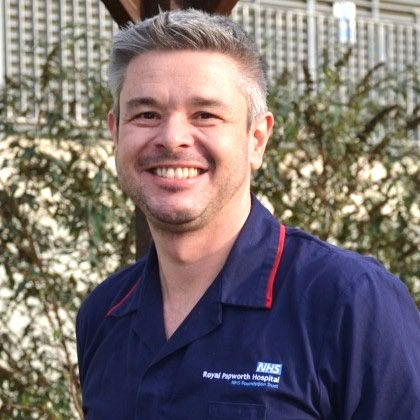
Stephen Parish
Palliative Care Education Facilitator/ Clinical Nurse Specialist in Supportive and Palliative Care, Royal Papworth Hospital NHS Foundation Trust, Cambridge
Biography
Stephen Parish is a Palliative Care Education Facilitator and Clinical Nurse Specialist in Supportive and Palliative Care at Royal Papworth Hospital NHS Foundation Trust, Cambridge. His work focuses on supporting patients, families and healthcare professionals facing complex palliative care needs, particularly in advanced heart and lung disease.
He has a strong interest in education, communication and the psychological aspects of serious illness, and in helping clinicians navigate situations where specialist treatments, implanted devices and palliative care intersect. Alongside his nursing and education roles, Stephen also has a background in counselling, which informs his approach to communication, teaching and person-centred care.
Session
Thursday 11 March
16:45-17:45
Quays Theatre
Symposium - “Help, I don’t know what to do!” Dying with devices, transplants and rare heart and lung disease
Royal Papworth Hospital is a specialist cardiothoracic hospital and a regional, national and international centre for advanced heart and lung care. Many patients are supported by highly specialised interventions such as left ventricular assist devices (LVAD) and organ transplantation. These treatments can transform what is possible, extending life and offering hope where few options previously existed. YET many of the patients known to Royal Papworth hospital are also living with chronic, progressive and life-limiting illness. Some will die in hospital, but many will be cared for by local community palliative care teams, hospices, primary care and district nursing services. THIS transition can be difficult. Community teams may be asked to support patients with conditions or devices they have rarely, or never, encountered before. They may be uncertain what deterioration will look like, which symptoms to anticipate, what can safely be stopped, and when and how to access specialist advice. Patients and families may also have long-standing, trusting relationships with tertiary teams, making the shift to local end of life care emotionally and practically complex. THIS symposium will explore the palliative care interface between highly specialised cardiothoracic medicine and community care. Using three patient vignettes, we will consider dying with advanced bronchiectasis, dying with chronic lung allograft dysfunction after transplantation, and dying at home with an LVAD in place. THE session will ask how specialist centres can act not only as providers of advanced treatment, but also as continuing resources for patients, families and local teams when treatment is no longer able to change the outcome. The aim is not to turn community teams into cardiothoracic specialists. It is to share a transferable model of partnership between tertiary and community palliative care, so that patients with rare or technologically complex conditions can receive excellent end of life care wherever they are.